
Adjacent
On the spaces between belonging

Last April, I wrote about komorebi (木漏れ日), sunlight filtering through leaves. I was on a trail at Keppel Hill, Foolittle strapped to my chest, his small weight the whole point of the walk. He slept through most of it. I didn’t mind. I was carrying him into something I hoped would settle slowly in him, the way light does.
A week ago, I joined another mothers’ walk along the Rail Corridor from Hillview to Ulu Pandan. 7km of greenery, movement, and conversation. But this time, Foolittle was not on my chest. He was at school, learning to pay attention, to socialise, to exist in a room without me. And I was on a trail, arms swinging free, learning something similar.
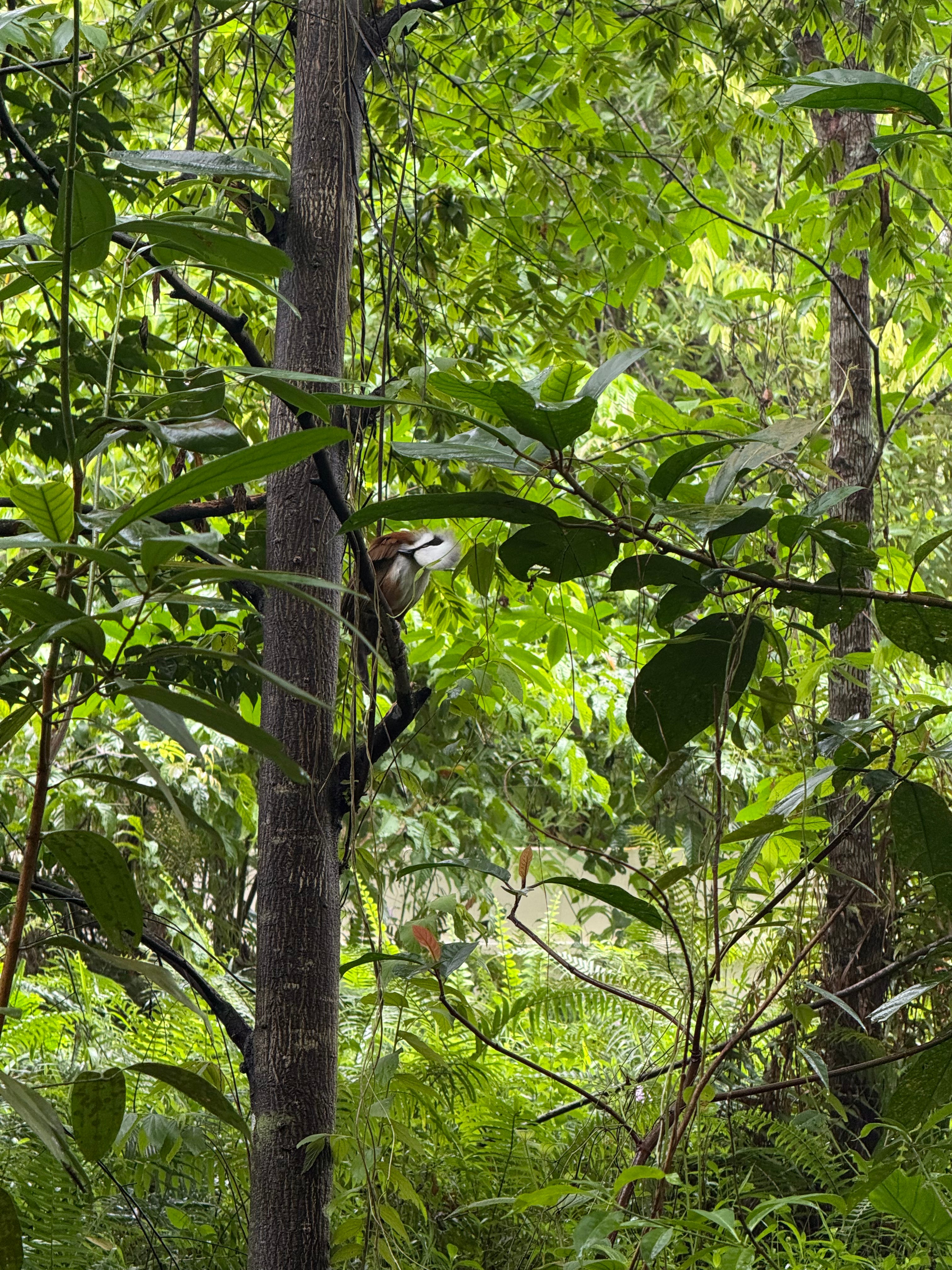
There is a particular kind of lightness that comes when a weight you have carried for years lifts. It is not the lightness of relief, exactly. It is more uncertain than that. You have held the shape of something for so long that when it goes, you feel the outline it leaves behind. Your arms remember, and your centre of gravity has not caught up.
I kept reaching for him subconsciously in the small adjustments. Hugging my front and then remembering his solid weight was not there, not being able to stand still but instead, gently swaying side to side. The body remembers a task longer than the task requires it to, and I think that is its own kind of tenderness.
We introduced ourselves in pairs and threes as we walked.
Many of the women had never done this stretch of the Rail Corridor before. When it was my turn, I mentioned walking parts of it more than ten years ago. Back then, I was training with the intention of summiting Mount Fuji and Mount Kinabalu. Since the topic of the upcoming school holidays came up, I mentioned solo trips I had taken with my children.
One woman said she had never met someone who had actually done solo trips with young children and had questions about why I did it. I appreciated their curiosity. But I could eventually feel the conversation reaching a natural wall, the point where interest becomes something closer to anthropology, and I found myself editing down, making the trips sound smaller than they were.
Another exhale, and a slight shift in the air before conversation returned to familiar ground. School closures. Calendar coordination. The difficulty of aligning children’s schedules with spouses’ work.
I have felt this before.
I have felt this most of my life.
I have rarely fit neatly into whatever template was dominant in the room. In tech, it was trying to find my voice in a room dominated by men, many 15-20 years ahead of me. In motherhood, I still talk about mountains. I orbit many groups, and in most of them I am adjacent. A little off-centre. Present, but angled.
Even here, in a self-selected group of women who had chosen green, I was still slightly to one side. The forest does not automatically gather your people.
Most of the women came from the public sector or were running their own businesses. Many had stepped back during their caregiving years. The hours alone filter who can come, because a Friday morning walk at 9am narrows the field by default. I only met two ladies who came from places where I was close enough to recognise the pace, but different enough to confirm the distance.
As I fill my plate with work once more, the strange thing is how easy it feels. The shift back into that mode is almost pleasurable, like discovering you can still read in a language you thought you had forgotten. The words come back. The syntax is yours, has always been yours, and you feel it return not with effort but with recognition. The pleasure of a fast problem, of thinking alongside adults, of being myself in a room rather than only someone’s mother.
What catches me off guard is the other direction. The session ends, and I have forty minutes before pickup, and I cannot quite find the gear that takes me from strategy and timelines back to “shoot, we’re late.” It is not that the work is hard to enter. It is that the work is hard to leave. The mind wants to keep going, and instead you are cutting grapes in half and answering questions about why birds have different-shaped beaks.
Foolet asked why I am back at work.
“Well, I get to earn money,” I said. “And I enjoy it.” (He’s currently a bit more conscious about money since he’s been counting his red packet money and thinking how he can persuade me to let him buy something he likes with a portion of it.)
“I remember your old office. I liked labeling things.”
“You were a great help.”
“But Daddy’s office is nicer.”
I am reminded that my children are watching this transition too. They are forming their own understanding of what it means that I am slowly becoming a little more mine again.
Full-time is not possible right now. This is still a caregiving season, with its own shape and demands. My current work fits because it bends around pickups and decompression hours and the emotional weather of the household. Nothing gets handed back when you return to work as a primary caregiver. You quietly add.
I think about adjacency more than I used to.
It is not the same as loneliness, though they share a border. Loneliness is the absence of connection. Adjacency is connection at a slight angle. You are there, you are in the room, you are part of the conversation, but your centre of gravity sits somewhere the group does not quite reach. You participate genuinely and still head home feeling like you spent the morning standing one step to the left.
The world I spent a lot of time in before does not naturally produce people who spend their mornings walking slowly through green. It produces runners tracking splits. And the world I am in now, of caregiving mothers finding their way back, does not quite know what to do with someone who once trained for altitude.
It’s difficult to fully share a transition that others have not taken the same shape of. You find companionship in pieces, in temperament rather than demographic, in the occasional person who has also measured their life in trails and the particular solitude of going against the grain.
They are fewer, and more dispersed. But they exist. And you find them the way you find anything real, slowly, without a map, one honest conversation at a time.
There is something about walking that makes all of this lighter. It does not resolve it completely, but I end up carrying it differently. Maybe it is the rhythm, or maybe it is that the forest does not require explanation. You are either there or you are not, and it does not ask you to account for the distance between where you stand and where the group expects you to be.
I keep returning to komorebi. Light does not force its way through leaves. It finds the gaps, the spaces that have opened, that were not there before. It does not mourn the closed places. It just moves toward whatever is available.
Foolittle is finding his gaps at school. I am finding mine on Friday mornings, in work calls, in essays written at the edges of the day. Foolet is watching all of it, forming conclusions I will not know about for years.
I used to wonder if adjacency was something to solve, a problem of fit. Maybe it is just what happens when you have spent your life not quite on the beaten path. Not lost, not wandering, just walking to the beat of your own drum.
The gaps may keep changing, but the light is patient.
Have you been in a season of recalibration? I would love to hear where you have been finding your people.